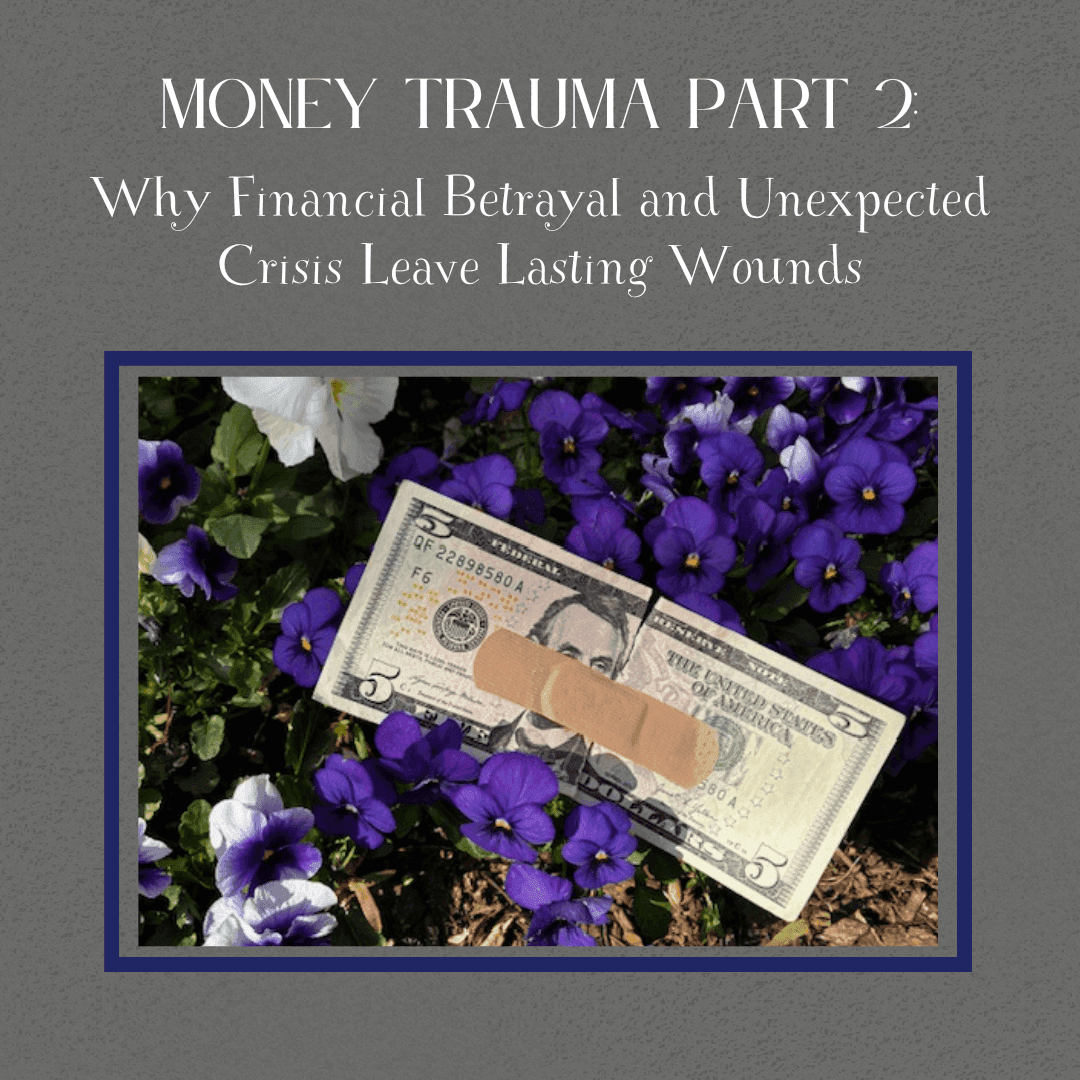
In last week’s blog, I talked about how money trauma can form early—through the messages you absorbed growing up, the instability you may have lived through, and the ways scarcity or inconsistency shaped how you relate to money today.
But for many people, the story doesn’t stop there.
As an Alpharettatrauma therapist, I have seen how money can become painful later in life too—through relationships that leave you feeling financially unsafe, or through unexpected events that shake both your emotional and financial foundation at the same time.
And when that happens, money doesn’t just represent numbers anymore.
It starts to carry the weight of what you’ve been through.
When Money Becomes a Trauma Wound in a Relationship
One of the most painful ways money trauma can form is within a relationship.
Because money in a relationship is never just about money.
It becomes intertwined with trust. With partnership. With the sense that you’re building something together—that you’re not carrying life on your own.
And when that breaks down, it doesn’t just create stress.
It creates a wound.
You might have found yourself in a relationship where:
Money was hidden or not fully disclosed
You were left to carry the financial responsibility while the other person spent freely
Conversations about money turned into conflict, avoidance, or dismissal
You felt like you had to hold everything together just to keep things stable
Over time, that has an impact on you.
Not just practically—but emotionally.
Because instead of money representing safety, it starts to represent something else entirely:
Uncertainty.
Instability.
Being alone in something that was supposed to be shared.
And for many people, there’s a moment where it shifts.
A moment where you realize you can’t rely on the other person in the way you thought you could.
That moment often doesn’t get named as trauma.
But your system feels it.
You may notice yourself becoming more alert. More watchful.
Paying closer attention to spending, accounts, and patterns.
Feeling tension rise when money comes up.
Not because you want to control everything…
But because at some point, things felt out of control.
And your system learned:
If I don’t stay on top of this, things could fall apart.
Even if the situation changes later—
Even if things improve—
That internal response doesn’t just disappear.
Because what was impacted wasn’t just your finances.
It was your sense of safety in the relationship.
When Life Changes Everything All at Once
Not all money trauma comes from relationships.
Sometimes, it comes from moments in life that you didn’t choose… and couldn’t prepare for.
An accident.
A medical emergency.
A sudden loss.
The kind of moment where everything shifts, and you’re left trying to find your footing in something you never saw coming.
And in those moments, you’re not just dealing with one kind of stress.
You’re holding two things at the same time:
The emotional weight of what’s happening…
And the financial reality that comes with it.
You might be sitting in a hospital room, trying to stay present, trying to stay strong—
While another part of your mind is already racing ahead.
How much is this going to cost?
How are we going to pay for this?
What happens if this doesn’t get better?
There’s no space to slow down and process.
No space to separate the emotional experience from the financial one.
It all happens at once.
And when your system gets overwhelmed like that, it does what it’s designed to do—it shifts into survival.
You push through.
You figure things out.
You carry what needs to be carried.
But later… when things settle… something doesn’t quite go back to normal.
You may notice:
A spike of anxiety when unexpected expenses come up
A sense of dread around medical bills or financial uncertainty
A feeling that things could unravel quickly, even when they’re stable
A constant need to stay prepared, just in case something happens again
And sometimes, there’s another layer that feels harder to explain.
You may notice a shift in how you feel around the person connected to that experience. Not because you don’t care about them, but because your body remembers what it felt like to almost lose them… and everything that came with that moment—the fear, the uncertainty, the weight of what you had to carry.
So without fully meaning to, you may find yourself pulling back. Creating a little distance. Feeling a quiet tension you can’t quite make sense of.
And that can feel confusing… and even painful in its own way.
Logically, you might know you’re okay.
But your body remembers a time when you weren’t.
When everything felt uncertain.
When the stakes felt high.
When money became part of the fear, not just the solution.
And that’s the part that often lingers.
Not just the event itself…
But the way your system learned to associate money with moments when life felt completely out of control.
Trauma Experiences Don’t Just Go Away
One of the most confusing parts of money trauma is this:
Even when things get better…
The feeling doesn’t always go with it.
You might find yourself thinking:
We’re okay now.
Things have stabilized.
Why do I still feel this way?
And that can create a second layer of frustration—because now it’s not just the stress of what happened.
It’s the confusion of why it still feels like it’s happening.
But trauma doesn’t work on a timeline.
It doesn’t resolve just because the situation changes.
Because trauma isn’t just about the event itself—
It’s about what your system had to hold when it didn’t have the space, support, or safety to fully process it.
When you are:
Emotionally overwhelmed
Financially strained
Carrying more than your share
Or trying to hold everything together while something is falling apart
Your system shifts into survival.
And in survival, your focus isn’t on processing.
It’s on getting through.
So instead of being fully processed, pieces of that experience get stored.
And those pieces show up later in ways that don’t always seem connected on the surface.
You may notice:
Difficulty relaxing, even when things are stable
A need to stay ahead of every possible problem
Feeling responsible for preventing things from going wrong again
A sense that if you let your guard down, something will slip through
From the outside, this can look like overthinking or control.
But underneath, it’s something much more human:
Your system is trying to make sure you never have to feel that overwhelmed again.
When The Invisible Role You Learned to Play Becomes Trauma
There’s another layer to this that often goes unspoken.
It’s the role you may have stepped into during those moments.
The one who:
Figured things out
Carried the responsibility
Made sure everything kept moving
Didn’t fall apart, even when it felt like you could
At some point, you may have become the one who holds it all together.
And on the outside, that can look like strength.
Like capability.
Like resilience.
But inside, it often comes with a cost.
Because being that person can also mean:
You don’t get to fall apart
You don’t get to need as much
You don’t get to set things down
And even when life changes…
Even when things stabilize…
Your system doesn’t always know that it’s allowed to let go of that role.
Because at one point, it wasn’t optional.
It was necessary.
How Money Trauma Shows Up in Your Daily Life
Money trauma doesn’t always show up in obvious ways.
More often, it shows up in the small, everyday moments that feel harder than they “should” be.
You might notice:
A tightness in your chest when you check your bank account
Avoiding financial decisions because they feel overwhelming
Guilt when you spend money on yourself
Pushing yourself to work harder or do more to feel secure
Tension in your relationships when money comes up
A lingering sense that things could fall apart at any moment
And then, often without realizing it, you add another layer on top of that:
You start judging yourself.
Other people handle money just fine.
I just need to get it together.
But this isn’t about willpower.
This isn’t about discipline.
This is about your nervous system responding exactly the way it learned to when things didn’t feel safe.
Healing Money Trauma by Healing What Happened
The struggles you face around money are often not actually about money.
They are a reflection of what you’ve been through.
Healing money trauma starts with healing the experiences that shaped how you think and feel about money in the first place.
It’s not about pushing yourself to just be better with money.
For example, if your money trauma is tied to a life crisis—like an accident that left you facing overwhelming medical bills—the impact often goes far beyond the financial strain itself. In that moment, your system wasn’t just trying to manage expenses. It was trying to hold fear, uncertainty, and the pressure of everything changing all at once.
So later, when money comes up, your body may respond as if you’re still in that moment—tense, alert, bracing for something to go wrong.
As you begin to process and heal what happened during that time, something starts to shift.
The emotional intensity begins to loosen.
Money no longer feels as urgent or threatening.
Instead of reacting from fear, you’re able to engage with it from a more grounded, steady place.
The same is true when money trauma comes from betrayal in a relationship.
Healing financial betrayal isn’t just about learning to trust another person again—it’s about learning to trust yourself.
When money was hidden, misused, or placed on your shoulders unfairly, it can quietly shake your confidence in your own judgment. You may find yourself second-guessing decisions, overthinking choices, or feeling a lingering fear that you might miss something important again.
But as you begin to process that betrayal, something begins to separate.
You start to see what actually happened…
And what you came to believe about yourself because of it.
And often, the truth is this:
You weren’t incapable.
You were navigating something that wasn’t safe.
From that place, your confidence can begin to rebuild—steadily, and in a way that feels grounded and real.
Last week, we talked about finding balance—about allowing yourself to spend reasonable amounts of money on yourself while still covering your needs and planning for the future.
And this is where that becomes possible.
Healthy money management isn’t about deprivation.
It’s about creating enough stability to meet your needs…
Allowing yourself to enjoy what you have…
And building toward the future from a place of steadiness instead of survival.
You’re Not “Bad with Money”—You’ve Been Carrying Something Bigger
If you see yourself in any part of this, I want you to hear this clearly:
This isn’t because you’re doing something wrong.
It’s not because you lack discipline.
It’s not because you’re irresponsible.
It’s often because your relationship with money has been shaped by experiences that were overwhelming, painful, or out of your control.
And your system adapted the best way it knew how.
And it’s also something that can shift.
You Don’t Have to Figure This Out Alone
If you’re starting to recognize patterns of money trauma in your own life, you don’t have to untangle it by yourself.
In trauma therapy, we don’t just look at surface-level behaviors.
We gently explore:
The experiences that shaped those patterns
The emotional weight you’ve been carrying
And the ways you can begin to feel more grounded and steady moving forward
If you’re in Alpharetta or anywhere in Georgia, I offer therapy for adults both in-person and online.
You can reach out for a free 15-minute phone consultation to see if this feels like a good fit.

Kristy Brewer is an Alpharetta therapist who helps people find peace amid the chaos and offers in-person and online therapy across Georgia. Her specialties include trauma therapy, attachment therapy, anxiety therapy, depression therapy, and parents raising a traumatized child.
Request a free 15-minute phone consultation today by clicking here.